
Gretta’s Autism AMA, April 2022
For Autism Awareness Day in April, 2022, I ran an AMA (Ask Me Anything) about autism on my Facebook page.
FB is now kind of a dumpster fire so I’ve ported the main content over here. I did not port the comments, even though there was really good stuff in there, because tracking down permission from everyone in the discussion would have been tedious.
A lot of what I’ve written here is guesswork and might be wrong. Even so, I hope you get some value from it.
Intro
April 1, 2022
April 2nd is Autism Awareness day. I was officially diagnosed with autism in February, after a few years of growing awareness of my own, so this is my first day claiming this day for myself and putting myself out there.
Like most people, I move in multiple circles. Three of my biggest circles on Facebook are my family and childhood friends, the people I met during my computer science / tech career, and the people I've met during my career as a therapist.
My therapist friends were utterly unsurprised by my diagnosis - or maybe they just have better poker faces? But I think, as therapists, they mostly have an up to date understanding of what autism is and how it can show up in AFAB people. They've seen a variety of presentations in their own clients. The reaction there has been, "yep, cool, how do you feel about it?"
My tech friends were a little more surprised, but only a little. "Well, that makes sense, given that most of us seem to be autistic!" is a common reaction. And it's true - there's a high prevalence of neurodivergence in tech. At companies like Google, where I used to work, I think the interview process actually selects for it in some ways. We called it "culture fit" but a lot of times it was really just, "do you think kind of like I think?" And if you start with a pool of Googlers that's on the autistic side, then you're gonna get more of that as you go along.
It's been my family and childhood friends who have been the most taken aback. Without the exposure to the weird world of tech or the even weirder world of psychotherapy, a lot of folks from my earliest years don't have great information or examples to go on. I've gotten a lot of "But you don't seem autistic!" or "That can't be right!"
But I assure you, it's right. I'm super duper autistic, and I always have been.
So I want to invite you, any of you, doesn't matter how you know me, if you're seeing this post, go ahead and ask questions, even if you're afraid they might be rude. Anything you want to know about autism, about me, about how it's shown up in my life, about your disbelief or how it doesn't make sense to you, whatever you want. I might answer here in the comments, or I might make new posts, haven't decided yet. Fire away!
ETA: I'll be doing a series of follow-up posts answering each of the questions one at a time. Thanks for reading!
The Assessment / Diagnosis Process
April 2, 2022
I got a lot of excellent questions on my Autism Awareness post, and I'll be answering them one by one. Here's one from Aubriana Teeley:
QUESTION:
I'd be interested in hearing what the assessment/diagnosis process was like for you. What tests did they use and how was it for you? I am always curious about how it feels from the client perspective!
ANSWER:
I’ll start by sharing that there is much more demand for assessment, particularly affordable assessment, than there is supply. Most practitioners who can do an official autism assessment seem to have multi-month waiting lists, and if you want to pay for that assessment with insurance, especially medicaid, the wait can run multiple years.
On top of that, the very definition of autism is changing out from under us. The DSM definition - the only one that really counts when rendering an official diagnosis - is behind the times and is based on how autism sometimes looks in relatively weathly cis white boys. It talks only about behavioral manifestations and nothing about what’s really going on with sensory and nervous systems. Practitioners have no choice, if they are rendering official diagnoses, in following the DSM or possibly in some contexts the WHO’s ICD criteria. Even though they are restricted to use these sanctioned criteria, some practitioners do better - they’re better informed, more up to date, and more aware of different manifestations in different kinds of humans - and some practitioners don’t.
So, it’s tough out there if you want to get an official assessment. First you have to find someone who will even do it within your budget. Then you have to wait a long time. And then you have to hope they don’t suck at it and will be able to evaluate you appropriately given your background and context.
For all of these reasons, a lot of people are turning to self-diagnosis for autism and a variety of other conditions. That’s where I started too. I read a stack of books, read lots of websites and forums, took a lot of quizzes and assessment tools, took a lot of notes, and talked to a lot of people. I wrote a google doc amassing my evidence - in both directions - that ran to dozens of pages. (Hint: if you write long-ass google documents about whether you’re autistic, you might be autistic.)
In the end, though, I decided to get an official diagnosis. I did it for a lot of reasons. I wanted to know what the assessment process was like. I wanted to read the report the psychologist wrote about me and see what evidence they cited as most compelling. I wanted to see if I would learn anything from the process. I wanted to be able to describe the process to my own clients. And, if I’m being honest, I wanted validation from someone who had seen hundreds of cases and ruled “no” on some of them. I thought it would feel more real and eliminate some doubt in my mind if I went through the process (and it did!).
So I got on a bunch of waitlists. It took about a year before I was finally seen by someone. It cost about $1500. There was a lot of paperwork to fill out in advance - starting with long questionnaires that I think were home-grown by the specific psychologist I was seeing. I believe the intent of these was to weed me out if I was highly unlikely to be autistic - to save me the $1500. I passed that bar, so then she sent me some instruments to fill out: the RAADS-R and the SRS-2. I found out later that the RAADS showed me in the autism range, while the SRS-2 showed me as very slightly subclinical, meaning if that was the only instrument used then I would have been deemed not autistic. Finally, I met with the psychologist for a couple of hours and she did the MIGDAS-2 interview.
A few quick notes about the RAADS-R: the copy of it that my psychologist sent me to fill out actually had the scoring rubric attached to the PDF, so of course after I took the test I scored it myself and submitted the scoring alongside. (Hint: if you score your own autism assessment instrument, you might be autistic!) Second, if you want to take the RAADS-R, you can find it online at https://embrace-autism.com/ - an excellent site overall. Taking the RAADS is a step up from the usual online autism quizzes - this is a real instrument actually used in assessments. However, it really does work better in concert with a bunch of other stuff. Getting a fully history and the qualitative interview do actually add value - so I wouldn’t put too much stock in what one instrument says without any other cross-checking or context.
The psychologist told me at the end of the interview process, “I have no doubt in my mind that you’re autistic.” However, it took a couple of weeks before she wrote up the assessment with all of the detail about why and sent recommendations for support.
All in all I found the process enjoyable and I did learn more by doing it. There’s a chance I’m going to get partial reimbursement from insurance, but even if I don’t, I’m glad I went through the process. If I were not also in mental health, though, I don’t know if it would have been worth it. It’s a lot of money, and the little tidbits I gleaned were small compared to what I learned through my own research and investigation.
What’s (Un)Cool about Autism?
April 2, 2022
I got a lot of excellent questions on my Autism Awareness post, and I'll be answering them one by one. Here's one from Duncan Sabien:
QUESTION:
If you could push a magic button, which things about autism would you keep and which would you get rid of (assuming you could pick and choose)?
ANSWER:
Good stuff first.
I really like how my brain works, in general. I like the way I think about things, the way I collect information, sort through it, make sense of it, digest it, synthesize it, and explain what I’ve learned to others. This is how I add value to the world. It’s remarkably consistent across all the different jobs I’ve had, even though the jobs look so different on paper. This is probably the same thing as “having special interests.”
I know a lot about a few things, and I know a little about a LOT of things. I read fast and I file the information away and it’s there later when I want it - or at least, there’s enough there that I can chase it back down again. I like that too.
I’m really good at systematizing: not just doing a thing, but inventing a great process for doing a thing repeatedly.
I like hyperfocus. I think I’ve gotten a lot of benefit from it without too much of the downside.
I have sort of funky executive function. I need a lot of silly workarounds to get task initiation to work properly. But all in all, I know how my executive function works, and everything that’s unfortunate about it, I’ve found a way to patch. So I’ll put that in the good column too.
Because I’m autistic, I get to have the autistic-to-autistic mind meld thing with other autists sometimes. Autistic people make awesome friends. They’re so interesting! Whatever they’re into, they’re really into, and they can teach you all about it. And if you don’t want to know about it, you can just say bluntly, “I don’t want to know about that,” and that’s okay, and then you roll again to see if you can find some other interests that do line up.
Now the not-so-good stuff.
It’s really easy for me to get dysregulated. I get overwhelmed by sensory stuff and/or emotionally tripped up pretty easily. As I mentioned in another answer, I used to blame other people for it when this happened. I was also really unaware of the early signs and so I would let it build and then be surprised when I suddenly lost it. I had a reputation as a child for being very “sensitive.” Later I toughened up and I was less “sensitive” but probably a lot more prickly to be around. So if I could push the magic button, I might wish to be more even-keeled overall - and to get that, I’d need to be less easily upset by the wrong sensory stimuli, and more aware of my own internal state and how to manipulate it.
I wish I could separate out different audio streams better. For one thing, then I might be able to understand lyrics to songs.
I wish I were less sensitive to - well - everything - so that I could fall asleep more easily in more environments.
When I think things are going to go a certain way, and then despite all my best efforts at modeling EVERYTHING about the situation to account for uncertainty, I am still surprised by an unforeseen outcome, I tend to be really ticked off and then it takes me a while to readjust and move on. I’ve gotten better about this - both in dealing with the unforeseen and in not overinvesting in modeling to reduce uncertainty - but wow all of this is a lot of work. And I’ve seen allistic people just sort of not care when the universe surprises them? That looks neat.
I could do without my statistical predilection for addiction to substances.
I wish I could reliably tell when people are joking. I can usually tell? I think? But if there’s any doubt then I still tend to play it straight, which might leave others who don’t know me well thinking I’m humorless.
I wish I had better interoception, so I would know what my body was trying to tell me about what it needs. Instead, I mostly rely on a pile of heuristics and hacks.
Doing Therapy While Autistic
April 2, 2022
I got a lot of excellent questions on my Autism Awareness post, and I'll be answering them one by one. Here's one from Niall Murphy:
QUESTION:
I have no problem believing that high empathy and grasp of detail would help autists to be great therapists, but I’m curious as to how you find treating NTs in the therapeutic context?
ANSWER:
Thank you for this question. I’m going to answer a set of broader ones, and I hope I’ll answer your specific question along the way. I’m going to talk about: Can an autistic person really be a therapist? Can they possibly be any good at it? Aren’t autistic people supposed to be bad at social and emotional stuff, and isn’t being a therapist all about social and emotional stuff? Maybe autistic people can be therapists for other autists, but aren’t they going to mess it up when they talk to neurotypicals or people with other types of neurodivergence?
(See, my questions are way ruder and more judgey than your question, Niall!)
Okay, so let’s start with the idea that autistic people are bad at social and emotional stuff. It’s right there in the DSM diagnostic criteria after all!
I personally was definitely very bad at social and emotional skills for the first two or three decades of my life. (Or four...) I couldn’t read other people very well. I was reactive and defensive a lot. When I felt uncomfortable, I got irritable and blamed others. I took things personally. I made it about myself a lot. I talked too long about things I was interested in, and wasn’t a particularly good listener when others wanted to talk. I took things too literally (and I totally still do!).
I got better.
I’m not telling you I’m awesome now. I still have all of these tendencies. But I got much, much better.
I got better because it wasn’t working - I didn’t like how my relationships with my partners and friends were functioning, or not. I went to a lot of therapy. I read a lot of books. I thought hard about it. I experimented. I tried to break down what was happening and why, and try something different, and see how that worked. And yes, I trained as a therapist, where I took whole classes on how to be a really good listener and not make it about myself.
It turns out, all of these things are actually skills. You can learn them. You can break them down into parts and improve each of the parts and get better at all of them.
Autistic people have a reputation for being bad at social and emotional skills for a few reasons. This is not the post where I’m going to break it down fully, but I’ll just tease for now that I don’t think being good or bad at this stuff is intrinsic to autism. I think it’s more likely than an autist will develop slower or not at all in these areas, but it’s not actually inherent to the condition, it’s more like a predictable result of the combination of autistic sensory differences and developmental context. That’s all for a later post.
Anyway, having learned these skills the hard way, I’m now actually in a really great position to be able to teach them. I know how they work at a really deep level, and when they’re not working, I can pinpoint which part is going wrong, and I have ideas about how to shore up that one specific spot.
So yeah, I think I’m a decent therapist, even for neurotypicals. Having weak social and emotional skills is not unique to autists, it can happen to NTs too, and they appreciate having a coach who can take them through it step by step, totally without judgment.
I’m not for everyone, as a therapist or as a friend. I’m pretty direct. I’m analytical. I remember to do the warm, soft, validating, holding parts of therapy, but it is something I have to remember, rather than something innate and automatic. Some clients really benefit from a slower, softer, squishier approach than I take. I talk about this when I meet with prospective clients. But overall, my approach seems to be working for a lot of people of all different neurotypes, so I guess I don’t have to quit and pick a third career, at least not yet.
And I really love the work! I’m fascinated by people and relationships. I’m so excited whenever I have a new client or client system - it’s like a puzzle I get to help take apart and put back together again. I’m so curious about them and how they work, and I think that’s part of what they like about me. It can feel really good to have someone else be fascinated by you, and I do that for my clients. I bring my hyperfocus and my attention fully to bear on them, and really try to “get” them. This is a very autistic perspective on what therapy is, but it does seem to work.
Please let me know if I got around to answering your question or if I missed the mark. Happy to follow up!
What Changed After Diagnosis?
April 3, 2022
I got a lot of excellent questions on my Autism Awareness post, and I'll be answering them one by one. Here's one that I got from multiple people (Julia, Jordanna, Laura, Aria):
QUESTION:
What, if anything, has changed for you following your diagnosis? Or is it more having a name or explanation for something you already knew about yourself?
ANSWER:
So, there was the self-diagnosis, which was more of a long term process, and then there was the official diagnosis, which I can pin to a moment in time. For this question, I’m going to sort of smush them together and conceptualize diagnosis as a process that culminated at a moment in time. There are really a lot of thoughts and feelings to unpack, so I’ll try to take them one at a time, more or less chronologically.
EARLIEST EXPERIENCES: “COULD I BE AUTISTIC?” - LATE 2020
It started with a strong fear reaction rooted in internalized ableism. I wasn’t very well informed about autism, despite being a therapist and having some autistic clients. I thought I knew about it, but I didn’t know what I didn’t know. When I considered that I might be autistic, I made it into a joke - “An autistic therapist? Can you imagine? What a hoot!” or diminished it. “Maybe I’m a little autistic.”
I talked about it with my closest friends. They didn’t laugh when I said I might be autistic. Their non-surprise surprised me. At first I was a little hurt (there’s that internalized ableism again). How dare they agree that I might be autistic? But the more they took it seriously, the more I took it seriously. The defensiveness started to wear off and the curiosity started to increase.
After a while, I realized that a diagnosis had no power to hurt me. I’m still me no matter what. Whatever I could do before, I can still do. However people experienced me before, they’d probably still experience me that way. Nothing is really changing. I’m a big fan of diagnosis in general, because it aids in understanding, allows people to research more efficiently, can help connect dots for symptoms people didn’t realize were related, and can help people learn from the experiences of others. Why not get all those benefits for myself, if I could.
Then I got into a research phase and started reading up. One of the hallmarks of autism is having special interests - topics that you get really deep into. And when a previously undiagnosed autistic adult gets interested in autism, well - there’s a predictable thing that can happen, and it happened to me. I got autism as a special interest. The deeper I got into it, the more my sense of amazement and wonder increased.
THE MESSY MIDDLE - 2021
“This makes so much sense.” That’s what I kept saying to myself the more I learned. I started a process of recontextualizing things that had happened to me in the past, looking at them with this new idea in mind. That’s still happening. Reexamining every awkward thing that ever happened can take a while when you’re 44 and you were secretly autistic the whole time.
I got to throw away some old labels. My mom used to call me her “little manic depressive.” It was not always said kindly. I am not here to rag on people with bipolar disorder, but any diagnostic label can hurt when it’s applied to you in a denigrating way, and this was. Autistic girls/women/AFABs often go through a long series of misunderstandings and misdiagnoses along the way. This was one of mine that I got to discard. It doesn’t actually fit.
As I got to the root of some of my more reactive or rigid behaviors and preferences, I got to let go of some of the guilt and shame I had associated with them. Like, why couldn’t I just chill about certain things? Well, it turned out there was a really good reason why I couldn’t just chill, and it was never going to change. Others who had been frustrated with me and expected something different from me were wrong. I was doing the best I could the whole time - the best I could do just wasn’t quite what they expected. It was a great relief to realize that I could let myself off the hook. These things that seemed so hard to change, that I just couldn’t budge - I could let them go. I could surrender and accept them.
But through this whole period, I was also riddled with doubt and guilt that maybe I was a pretender. Maybe I was stealing a label and identity that I wasn’t entitled to. Maybe I was like a medical student who thinks they have each disease they learn about in school. Maybe I was just an avid reader with an active imagination. Maybe I was taking something away from real autistic people with my imagined diagnosis. Maybe I wasn’t autistic enough, whatever that even means. These doubts definitely contributed to my desire to have a neutral third party with experience and qualifications have a look at me.
THE OFFICIAL DX AND AFTERMATH - EARLY 2022
So of course, once the psychologist gave me the diagnosis, my predominant feeling was relief and joy. I really did want it all to be true. It felt right, it explained so much, and I’d started to adopt it as my own. I wasn’t sure what I was going to do if the psychologist said I was wrong. I tried to tell myself it was just one opinion but it turned out I cared a lot, and I was definitely in the mood to celebrate after the call.
Soon after, I felt a strong impulse to write to every one of my former therapists and say, “Hey, you missed this. Autism also looks like me.” I wish one of them had mentioned this possibility to me much sooner. I learned a ton in therapy over the years that was all useful to me independent of neurotype, but having the autism framework sooner would have been immensely helpful. I also think we barked up some wrong trees. I’m thinking of multiple therapists who really wanted me to do eye gazing with my partners even though I told them in no uncertain terms that I hated eye gazing and found it deeply upsetting. I’m thinking of a perinatal specialist who did some pretty intense work to analyze my attachment style and history to explain my distress about caring for an infant, when looking at it from a sensory perspective would have been far more productive. I don’t blame these therapists, I think they were all doing their best. I have no doubt at all that I am missing some very important things with my clients right now. But I do want to spread the word about autism and how it looks, and that’s part of why I’m doing all this writing this week.
I’ve mostly stopped saying “they” and started saying “we” when I’m talking about autistic people. It feels good.
And increasingly, I’m coming out as autistic. I mean, obviously. That’s what this series of posts is all about. But I’ve been sharing it with my clients, too, one at a time, as appropriate. And sometime soon, I’m probably going to put it on my professional website. I’m not sure what effect that’s going to have. Probably it will make some clients decide not to work with me, even clients who would have liked me just fine if they didn’t know about my diagnosis. But I think that’s okay - there are a lot of great therapists in this city, and those clients can be well served by someone else. And meanwhile, maybe some people will change their minds about what it means to be autistic. If an autistic person can be a therapist, after all, maybe that’s something to be curious about.
Autism and Parenting
April 3, 2022
I got a lot of excellent questions on my Autism Awareness post, and I'll be answering them one by one. Here's one from Alyssa Pittman:
QUESTION:
How do you think this affects your relationship with your children? Some of the stereotypes about disliking pretend play or having a harder time deciphering someone's feelings seem like they'd have a bearing on parenting. Though kids often benefit from talking through feelings and emotional responses, so maybe it's helpful to need to do that! I wonder if traits such as being direct or using routines are helpful with young children too.
ANSWER:
I had my first child, Elliott, in 2004 - he’s almost 18 now! And then of course Nina is four and Maya is two - they just had their birthdays last week.
I think being autistic made it profoundly difficult for me to handle the newborn and infant stages of parenting. Between having a twitchy nervous system and needing a very low-stimulation environment for sleep, I got very little rest at all when my first child was a baby. I’m not talking about the usual amount of sleep deprivation that any parent gets - I’m talking about just not sleeping. Any solution that allowed for me to hear the baby cry also allowed for way too much incidental noise, either from the baby just breathing or from the static of a baby monitor - and I couldn’t sleep. And as you might know, if you take away a person’s ability to sleep, they completely lose their marbles (that’s a technical term) pretty soon thereafter - and that’s exactly what happened. I had postpartum depression with suicidality and almost didn’t make it through after Elliott was born.
It was a bad enough experience that I decided not to have any more children. The only reason I changed my mind was that my partner and I did well enough in our tech careers that we could afford to hire overnight help. If I hadn’t been able to afford that, I definitely wouldn’t have had more kids.
And that’s just the infancy part! Your question was really about parts that come later.
I do find the toddler and preschool ages really tough too. There’s just a lot of need, a lot of interaction, a lot of minute to minute demands, none of which permit for the kind of deep thought and concentration that my brain craves. This very post is taking me a loooooong time to write because in the last twenty minutes alone, my kids have wanted: their milk warmed up, their milk cooled off, for me to get the markers out of the cabinet, their paper torn out of the paper pad but torn out on the perforation not from the spiral binding, consolation because their stuffed animals are not lying in a pile the way they want them to, help hanging streamers from the ceiling, a hug after an unspecified minor injury, for me to reprimand the dog for chewing on something she shouldn’t, for me to carry an armload of toys down the stairs, … I think there was more.
It’s not that any of this is so unusual or that allistic parents don’t also struggle with this level of demand. I think this part is hard for most parents. But because I’m autistic, some of the sensory stuff that runs in parallel really grates on me in a way it wouldn’t for an allistic parent. And without time to focus and think and make independent decisions about my own time and energy, I quickly begin to unravel. It’s impossible to tell what’s just normal parenting wear and tear and what’s due to my autism, but I do think young children are a lot harder on me than most.
I should add at this point that I know of other autistic parents who don’t have the struggles I’m describing. It’s not universal at all. I don’t understand it very well.
Okay, so let me finally come to the parts you were really asking about - pretend play, emotion coaching, routines, and so on!
Each of my kids is different. I’d be shocked if I were the only neurodivergent person in my family. It’s not for me to diagnose my kids, but what I can say is that autism is highly heritable. So some preferences that I have because of my autism might suit my kids just fine too.
Pretend play: Elliott wasn’t super into it, Nina is VERY into it, and Maya is just beginning to pick it up. It’s not my personal favorite, but, like, I get how it’s done and I’m willing to go along with it if a kid wants to?
Emotion coaching. This is when a child is having a big feeling and the caregiver helps them make sense of it by giving it a name and validating it. I don’t think I knew very much about how to do this when Elliott was small, though I did read the excellent book How to Talk so Kids Will Listen and Listen so Kids Will Talk, and that helped me do a lot more validating than dismissing. I think I’m an excellent emotion coach for Nina and Maya, and as a result they’re growing up with pretty decent awareness of and vocabulary for their feelings, and they have some idea how to ground themselves when they get upset. I’ve definitely seen Nina choose to take a deep breath when she’s getting wound up. Of course, they’re both small people and have overwhelming feelings a lot of the time, coping strategies or not!
Routines. We all love ‘em. Getting ready for bed the exact same way every time is very soothing to all of us.
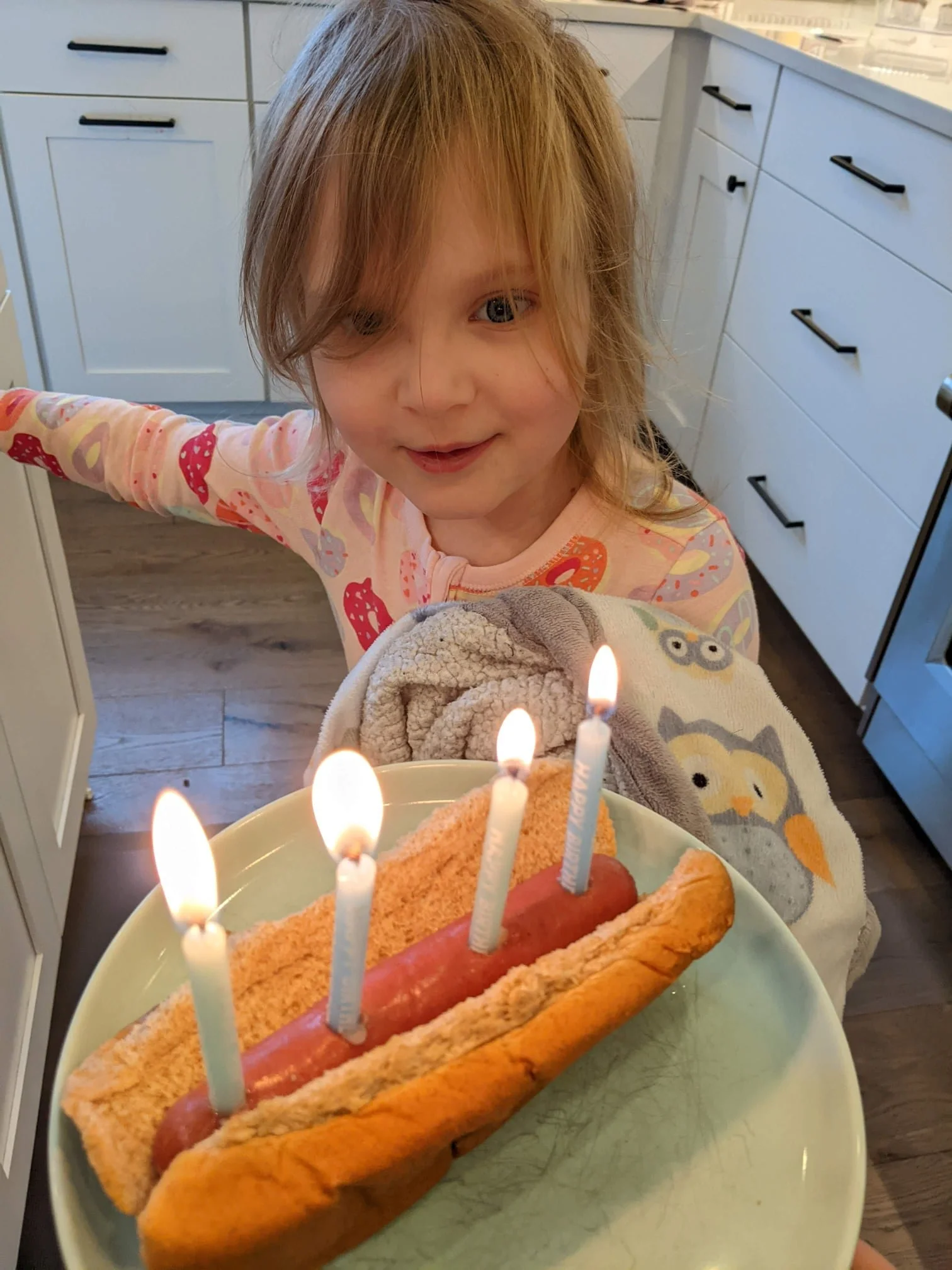
And I guess there’s one more thing I’ll add here. My attitude about most things with my kids is: that which is not forbidden is permitted, and I try not to forbid anything without a good reason. So, Nina wanted a hot dog with birthday candles at 8:45 on a Sunday morning. There was no good reason why not, so that’s exactly what we did. I think autistic people often have a kind of unawareness of or disregard for convention. “Hot dogs are a lunch food” or “we already had breakfast” or “it’s not your birthday anymore” are not good reasons to me, though I have a hunch that a lot of allistic parents might say one of those things. And I think that probably makes me a pretty fun parent a lot of the time.
I feel like this post is very disjointed. I started writing it three hours ago. All three of us are sick and I got distracted a lot while writing. But given that it’s about parenting, and parenting is exactly what’s distracting me, it’s just going to have to do. I hope you got some of the info you were looking for!
What Is Autism?
April 4, 2022
I got a lot of excellent questions on my Autism Awareness post, and I'll be answering them one by one. Here's one from Benya Fallenstein:
NOTE ON THIS POST IN PARTICULAR: I got a lot of pushback in the comments of this post, much of which made me think. Some of my fellow autists had very different ideas about what autism actually is. I’m including my original post anyway because I still like it as a general framework and I think it has a lot of explanatory power, but you should not put your full weight on it.
QUESTION:
what is autism
as in, what is different about how autistic brains work, and how does this cause autistic people to experience the world differently
ANSWER:
Okay, before you start reading: check. Are you comfortable? Do you need a drink? To go to the bathroom? Are you warm enough? Is anything pinching? Fix all that first, because reading this is going to take a little while. I’ll wait.
…
Now that you’re back, let’s talk about what autism is! (Hint: if my prompts about your physical comfort helped you notice anything, you might have poor interoception. We’ll come back to that later.)
We’re going to take this from the ground up. We’ll start from the senses, then get into the brain and nervous system. Then we’ll talk about feelings and thoughts and finally behaviors.
THE SENSES
It turns out there’s a lot of debate about how many senses we have. There are good arguments for various numbers, but I’m going to go with eight: the five you learned in grade school, plus interoception, proprioception, and the vestibular system.
The senses are the input interface from the world into your brain. Everything you experience, all the data you ever take in, comes in through your senses.
Did you ever wonder if different humans have different experiences of the same sensory input? I can remember wondering as a child if the color I saw as red “looked” a different way to other people. Like, if I could connect my brain to their eyes (I was a little fuzzy on exactly where we’d unplug the systems and replug them together), would everything just work? Or would something get mixed up and actually look yellow now?
Processing sensory information is inordinately complicated and I’m no expert on it. What I’ve gleaned so far is that for each sense, there’s a lot of opportunity for different organisms to perceive the same input in different ways. When a signal (say, photons hitting your retina, or sound waves hitting your tympanic membrane) enters your body, lots of different parts of your body and brain get a chance to weigh in on what happens next. There are multiple steps of filtering, modulation, processing, integrating, and ultimately meaning-making.
So to answer my childhood question: yes, different humans have different experiences of the same sensory input. Sometimes, VERY different.
Autistic people have VERY different experiences of the same sensory input. That’s at the root of the whole thing. Here’s a whirlwind tour of common autstic sensory differences that will likely leave a lot out.
Visual: may find lights too bright, digital visual artifacts very noticeable and irritating
Auditory: misophonia (strong irritation or disgust at certain sounds), auditory hyperacusis, can struggle to both look and listen at the same time, can have trouble picking out one auditory stream out of many, can find “background noises” very hard to tune out
Tactile: may find light touch very activating/upsetting and prefer deep pressure, may have trouble with localization (figuring out where on the body a touch is), irritated by clothing textures, sensitive to food textures, may have a strong startle response when touched unexpectedly
Gustatory (taste): foods that taste good to others might not taste good to the autist, though this is also wrapped up in olfactory and tactile issues
Olfactory (smell): may have a heightened or reduced sense of smell, parosmia (phantom bad odors)
Interoception: awareness of internal bodily sensations and processes. Hunger, thirst, breathing, heart rate, need to use the bathroom, feeling warm or cold. Autists may have poor interoception.
Proprioception: awareness of where your body parts are and how much force to use to move them through space. Autists may have poor proprioception.
Vestibular: sense of balance. When this is off, you may feel ungrounded, unmoored, like you’re floating through space, very difficult to achieve a sense of well-being or safety.
THE NERVOUS SYSTEM
Okay, so far we’ve talked about how the inputs coming into the brain end up getting received and processed very differently in an autistic brain. But that’s not all there is to it.
We also need to talk about emotion regulation. I’m going to do this really fast and take some shortcuts, but l’ll define regulation as the process by which you feel okay when everything is basically fine and you feel agitated or upset when there’s a threat of some kind. Physiologically, it’s helpful and appropriate for our bodies to shift into high gear when something is badly wrong. Our ancestors needed to notice that a predator was about to eat them and then run really fast to get away. We still have all the same wiring that made that kind of life-saving response possible. There are lots of different stress responses, the most famous one being “fight or flight” (aka hyperarousal). I won’t do my whole spiel about all the other stress responses - there are a bunch.
When you’re in a stress response and your body and brain have switched gears to deal with that threat, we call it being “dysregulated.” And when you’re calm and feeling on top of the situation and like everything’s cool, we call it being “regulated.”
Autistic people get dysregulated really easily.
We’re not the only ones! ADHDers do too. People with a heavy trauma history do too. There’s lots of reasons why people end up with twitchy nervous systems.
Here I’m going to quote from Uniquely Human: A Different Way of Seeing Autism, by Barry Prizant, p. 18:
“People with autism, primarily due to underlying neurology (the way the brain’s wiring works), are unusually vulnerable to everyday emotional and physiological challenges. So they experience more feelings of discomfort, anxiety, and confusion than others. They also have more difficulty learning how to cope with these feelings and challenges. To be clear: Difficulty staying well regulated emotionally and physiologically should be a core, defining feature of autism. Unfortunately professionals have long overlooked this, focusing on the resulting behaviors instead of the underlying causes.”
THOUGHTS AND FEELINGS: THE INTERNAL EXPERIENCE
Okay, so far so good. Now let’s move up a level and take a look at what the autistic person may end up thinking and feeling.
So, imagine you’re a little autistic kid, but nobody knows you’re autistic, so they don’t know your sensory inputs are all scrambled and that your nervous system has a hair trigger. Your pants are too tight and the tag in your shirt itches and there’s an irritating whine coming from the refrigerator and the light is too bright. The only one of these you’re actually aware of yourself is the light. You feel crappy and irritable.
You: “Waahhh, Mommmmm, the light is too bright!”
Your Mom: “No, it’s not, honey, it’s fine.”
You: “Aughhh, my eyes hurt!”
Your Mom, irritated: “It’s fine. Stop whining and eat your breakfast.”
You stop whining and push your food around your plate. But, when your sister pokes you, you cry and start hitting her and you get in trouble.
From this and a thousand other interactions like it, you conclude that the light *is* fine and that whining doesn’t help. You stop speaking up about the light and eventually you even stop noticing the light. It’s just one of dozens of things that low-level bug you. You act like it’s all fine. This is what fine feels like, right? You’ve never known anything different. You assume everyone else is having the same experience you are. They’re all fine. Why shouldn’t you be fine?
You get progressively more disconnected from your own body and your sensations. You have no idea why you lose your temper so easily. You get a reputation with other people as difficult to deal with.
From this example, I’m hoping you can generalize into lots of different dimensions. So many developmental tasks are harder when the people around you are making bad assumptions about what it’s like to be you. And if you’re uncomfortable and dysregulated most of the time, that interferes with attunement and learning, and you can get further and further behind.
BEHAVIORS: THE EXTERNAL EXPERIENCE
So, finally, we arrive at behaviors. This is the only part most people think of at all when they think about autistic people. Autistic people are just weird, right? Here’s where all of that weird stuff shows up.
This is also the only stuff the DSM says anything about. There are two big diagnostic criteria for autism in the DSM: A) Deficits in social communication and social interaction and B) Restricted, repetitive patterns of behavior, interests, or activities.
Let’s take the social communication and interaction first. Okay, so according to the DSM, autistic people have trouble with normal back-and-forth in conversation, poor nonverbal communication, trouble with eye contact, lack of facial expressions, and difficulty in creating and sustaining relationships.
I don’t know how much of this is neurological and present from birth - as in, the wiring for making friends and interacting with others is just plain absent or different - and how much can be explained by the sensory stuff described above. But my hunch at this point is that a lot can be explained by the sensory differences.
Take the back-and-forth of conversation, for example. That starts getting trained very soon after birth. Very young infants take turns with their caregivers in making speech sounds and then listening to what the caregiver says.
But what if you’re an autistic baby and the blanket itches and the lights are all wrong and your parent is stroking you lightly and it’s making you want to jump out of your skin? You might be too upset to attune to your caregiver and practice the back-and-forth. So maybe you don’t learn that part at all, or you learn it incompletely.
And so on like that.
I’m not sure about any of this, but it makes sense to me. It also helps explain why there’s so much variation in social skill level among autistic people - it might come down to how pervasive your sensory processing differences are, and how unpleasant your environment was for you - and why it’s possible to learn some of it later.
Now let’s move on to the restricted, repetitive patterns of behaviors and interests. According to the DSM, autistic people like to line objects up, repeat phrases other people have just said, stick to the same routine come hell or high water, feel distress about small changes, have difficulty with transitions, get very interested in certain subjects, and have hyper- or hypo-reactivity to sensory input.
Well, they got that last part right for sure!
Almost all the rest of it can be seen as coping behaviors for dealing with a harsh and overstimulating world.
I’ve eaten the same breakfast every day for the last few years (and I had a different same-breakfast-every-day for a long chunk of time before that). I like my breakfast. It has a good nutritional composition, it fills me up for a predictable amount of time, it tastes good to me, and I find the textures in it very satisfying.
If I were to try to mix it up and have different breakfasts, probably something would get worse. Having my breakfast the same every day gives me control, predictability, a sense that I’m okay. Having a sense that I’m okay isn’t always easy to come by. This is such an easy win. Of course I’m going to take it.
But once you take the sum total of all the routines and rituals I’ve created - it gets to be a lot. And no, I don’t want to change any of it, and yes, I’m irritated by whatever gets in the way of it. I assembled my life this way for good reasons, thank you very much. This is what keeps me safe. This is what keeps me okay. This is how I stay in the regulated zone.
I think that mindset accounts for about 80% of Criterion B.
I can’t really explain special interests, though. I haven’t been able to draw a dotted line from “scrambled sensory input” to “trains are fucking awesome.” If anybody has any leads on that, please let me know.
IN CONCLUSION
All of this is just a working theory. I’m ready to hear new evidence about pretty much any part of it. I want to know more about this amygdala overgrowth thing that Logan and Benya were talking about. I want to know more about microglia eating too many/the wrong synapses being linked with autism. I want to know more about everything.
Suggested reading: the Prizant book referenced above
Logan’s tumblr, especially Original Seeing and Some Advice to my Past Self about Autism.
Unstructured Social Situations
April 5, 2022
I got a lot of excellent questions on my Autism Awareness post, and I'll be answering them one by one. Here's another one from Tony D’Souza:
QUESTION:
my understanding of autism has been that it makes it hard for people to infer implicit rules, esp. in unstructured social situations, because they struggle to "simulate" the minds of others so as to predict their behaviour; how accurate is that?
ANSWER:
Yes, that’s accurate, though it’s a matter of degree. Some autistic people can simulate the minds of others very well, while others can’t do it at all, and a few are not even sure why that would be a worthwhile or interesting exercise. Multiple autistic people have expressed offense to me about even trying, as though it would be rude to try to build a mental model of another person.
My quick answer to this question suggested that you look up the phrase “double empathy problem.” I like this concept because it places the simulation difficulties in more of a systemic context rather than as a deficit in the autistic brain. If you oversimplify the world and assume two kinds of brains, autistic and allistic, then you can posit that autistic people have trouble simulating allistic brains and allistic people have trouble simulating autistic brains. If you then undo your simplification and assume almost 8 billion kinds of brains, then you can posit that pretty much everyone struggles to simulate pretty much everyone else’s brain, and the more different the two brains are the more trouble there will be. That sounds about right to me.
A lot of the autistic experience in unstructured social situations is a guessing game. It’s as if all the other people got access to a hidden rule book and studied it ahead of time, and now we’re all going to interact according to those hidden rules. Oh, and by the way, if you break any of the rules, ignorance is no excuse, you’ll still be rejected / shamed / not get to accomplish whatever brought you into that space in the first place.
That’s why you’ll find autists engaging in any or all of the following:
Avoiding unstructured social situations
Loudly announcing their own intentions and hoping that others will model *them* correctly
Trying to impose more structure, or preferring socializing with a lot of structure built in (Complicated board games! LARPing! Heavily negotiated BDSM scenes!)
Hanging out mainly with other autistic people
Spending a lot of time pre-gaming social interactions and trying to predict what might happen and what to do next if it does
Saving up “spoons” for social interactions and then collapsing in a nervous heap immediately when they’re over
Probably more. That’s just what occurs to me off the top of my head.
As autistic people go, I’m pretty good at modeling what’s happening in other people’s heads, regardless of neurotype. It’s part of my job, but in a funny sort of way. We’re not actually engaging socially. They’re sitting still in a controlled environment, *telling* me about a thing that happened, and then part of my job is to help them figure out how they felt about that thing and why they felt that way. Or to help their partner figure out those same things. It’s the easiest possible version of person simulation because so many of the variables are controlled and because they want me to succeed at it. And I’m really good at it, in that context. I know I’m good at it, because when I correctly name their feeling and help them make sense of it, their whole body relaxes and sort of sinks down a little and their face gets less tight and they say, “Yes, that’s it. Wow, Gretta, you really get me!”
With all that practice in a controlled environment, I’ve gradually gotten better at it in the wild, too - I think. It’s hard to tell, because in real life I’m surrounded by neurodivergence. My partners and friends and kids - well, there’s not a lot of neurotypical brains to be found in my immediate environment. And the better I know someone, the more I’ve built a model of their specific individual brain, and predicting them gets easier. As soon as you put me into a truly neurodiverse situation I do tense up a lot and withdraw and try to get out of there as soon as I can, because I know I’m in foreign territory.
Thinking back on my childhood, I had the most discomfort, the most meltdowns, the most rejection, and the most feeling of alienation when I was youngest and in most diverse settings. As I got older I opted more and more into situations where there was more structure and, frankly, more autism, and I began to feel more and more comfortable and like I could be socially successful. Google was a great environment for me, for example. But I will never, ever be comfortable in a situation that’s, like, all the mothers of all the kids in my kid’s public kindergarten class. It’s the worst.
The DSM is Bad and it Should Feel Bad
April 5, 2022
I got a lot of excellent questions on my Autism Awareness post, and I’ll be answering them one by one. Here’s one from Logan Strohl:
QUESTION:
You've said that the diagnostic criteria are way behind the times. Where are some specific places where they most need to catch up (besides the "functioning" framing)? Are there specific criteria not included currently that you'd like to add? Would you take a completely different approach somehow? (Feel free to take this question wherever you want.)
ANSWER:
I felt a lot more confident about this before all of the interaction on my “what is autism” post, so I’m glad I saved this question for late in the game! It’s perfectly okay that I lost confidence given that my confidence was probably unfounded.
If I’d answered this question sooner, I might have been willing to take a crack at new criteria. I’m no longer willing to do that. But what I can do is make a laundry list of complaints. Not as close to any old solution, but maybe a better step on the way to a solution that’s actually correct.
Complaint #1: Behavioral criteria.
The current criteria are almost entirely behavioral, but I believe the behavioral symptoms are just that: symptoms. I also believe those symptoms could have many possible explanations as most of them have to do with managing dysregulation and dysregulation has many potential causes. It may be that once you look at the whole picture, this particular constellation of symptoms kind of sort of points to autism as the underlying cause, but I still find these criteria unsatisfying.
What I wish for instead is some way of measuring something closer to the root cause. I don’t know enough about the science to know what that would be, and probably nobody does yet. So maybe we can’t have that as the diagnostic criteria yet.
Second best, what I wish for is something more about the internal experience of the autistic person, rather than the externally observable behavior. And that’s not out of line with other disorders in the DSM.
Generalized anxiety disorder’s diagnostic criteria are mostly about internal experience: worry, feeling keyed up, difficulty concentrating, feeling irritable, feeling fatigued easily. Only a few are external/behavioral: muscle tension, sleep disturbance.
Major depression: same thing. Internal experience criteria include feeling sad/empty/hopeless, diminished pleasure, loss of energy, feelings of worthlessness, diminished ability to concentrate, recurrent thoughts of death or suicide. Only a few are external/behavioral: weight loss/gain, insomnia/hypersomnia, psychomotor agitation/retardation.
I suspect some of the difference is because autism is classified as a neurodevelopmental disorder - something present from birth (though maybe only manifesting later) - that traditionally, other people have decided is wrong with you. It used to be primarily diagnosed in children.
The closest comparison is of course ADHD, which is much the same: adults are looking at this kid wondering, what the heck is going on here? So of course they diagnose it using external behaviors rather than internal experience.
But just because something is present from birth doesn’t mean it’s caught early. The behavioral criteria feel woefully inadequate to me when diagnosing adults who can introspect about and communicate about their internal experience and may have some relevant data that doesn’t show in behaviors. Which brings me to my next point.
Complaint #2: The criteria don’t do enough to account for masking.
Masking, for those who don’t know the term, is when you do your best to act “normal” so you can fit in, even though underneath the surface you may feel anything but normal.
Autistic people often mask a lot, trying to act neurotypical, trying to guess the unwritten rules, trying to be social the way other people expect. There are countless hacks for this. Staring at a point right in the middle of someone’s forehead so it looks like you’re making eye contact when you’re really not. Mimicking behavior you’ve seen on a TV show or read in a book. Laughing when everyone else laughs even if you don’t get the joke. Sitting on your hands so you don’t fidget. Keeping a pleasant expression on your face even while you’re dying inside.
The better you mask, the more likely it is that you don’t get diagnosed early, and also the more likely it is that you don’t even know you’re autistic! You might think everyone is dying inside. It’s a shock to find out that some people actually feel comfortable. I can’t even tell you how many things are actually really hard for me that are easy for neurotypicals, and I just didn’t know. I’ve been faking it my whole life.
And it’s worse than that: if you’re good at masking, you don’t even meet current criteria! The current criteria can be rounded off to: “this person is bad at interacting with others and acts weird a lot.” But what if you summon all your energy, act normal as hard as you can, and then go hide in your room for a few weeks to recover from what it cost you? Are you still autistic? Yes, of course you are. But the DSM says not. Admittedly, there is some provision for masking in the accompanying text, but the criteria themselves are pretty unforgiving.
AFAB autistic people are more likely to put more energy into masking, because culturally, social skills are more valued in girls and punished when they are absent. This contributes to the underdiagnosis of AFAB autistics. Which brings me to my third complaint:
Complaint #3: Inclusivity.
The clinical picture was formed primarily with 5-8 year old white boys in mind. Substantial work has been done to broaden that picture but I claim we’re not done yet. And even if we do more research on a broader population, we also need to do better in acknowledging that social norms are highly culturally based. Interrupting others, for example, which is named directly as a symptom of ADHD and implicitly as a symptom of ASD, is a perfectly acceptable way to communicate in some cultures but not in others. So when we talk about social deficits, what do we mean exactly? How can we be sure we’re not dinging people for not being as much like rich white Americans as we want them to be?
Complaint #4: More autistic involvement and leadership in setting criteria.
Having a bunch of allistic people get together and decide what autism is without autistic people in the room is wrong. Having a bunch of allistic people as the final deciders with some autistic people as advisors (as happened with the DSM-5) is a little better. But there’s a lot more room here for autistic leadership in setting criteria. I mean, come on, who likes *making criteria* better than autistic people? This is right up our alley and also, stop speaking for us and about us, that's rude.
Complaint #5: The DSM is a political instrument, not a scientific one.
So this ain’t ever gonna change, but the DSM is for a lot of things, and “getting a really crisp scientific notion of what’s going on here” isn’t really one of them. There’s a lot of money and power tied up in where we draw the lines. This is the reason why I don’t really expect any edition of the DSM to do a perfect job or even a very good job. It would be lovely to have some other book that’s similar but has no power to make money flow and therefore can enjoy the luxury of just being correct.
Further reading: an account of how ASAN (the Autistic Self Advocacy Network) influenced the DSM-5 criteria with partial success.
What to Teach an Autistic Kid
April 6, 2022
I got a lot of excellent questions on my Autism Awareness post, and this is the VERY LAST ONE. I’m closing the doors on my AMA for 2022 after this one. I’ve had a lot of fun writing these up and I learned a lot from everyone’s responses. Thank you!
This question is from Laura Marsh:
QUESTION:
What allistic impersonating skills are you glad that you were expected to do over the years? Are there things that didn't come easy to you, but you are now happy to have those skills? Bonus points for things that have an intrinsic value to you instead of just "I'm glad I can do this because our culture expects it of me"
Asking from a perspective of a parent of a neurodiverse kiddo in choosing what is support and what is indoctrination
ANSWER:
So I dunno about allistic impersonation, I think most of that turned out to be bullshit actually, and the less of it I do now the happier I am. So I’m going to answer a slightly different question and I hope it’s still useful to you. I’m going to answer, “what should I teach my neurodivergent kiddo to help them navigate the world successfully without ending up giving themselves an anxiety disorder to go along with their neurodivergence?” The answer to this question is the same as the answer to the question, “Gretta, what did you learn really late in life that totally would have been awesome to know much sooner?” Some of these will be too advanced for your particular kiddo at age three so you’ll have to decide when is the right time. And some of them might not apply exactly, but you can alter them to suit.
1) Just because someone expects that you can do something doesn’t mean you can, or that it’s as easy for you as they think. They might not realize it’s hard for you. They might not have asked at all if they realized how hard it was. Treat most requests as the opening salvo in a negotiation, rather than as something that you have to do Or Else.
2) Get really, really good at negotiation and consent practices. This means getting really clear on what you want: what are your non-negotiables and your preferences, and also getting really clear on hearing what other people want, and then solving for something equitable that doesn’t cross anyone’s boundaries. This isn’t just a sex thing. This is for pretty much every joint activity of every kind. You’re going to need this, because other people aren’t going to be able to guess what’s going to work for you, so you’ll need to advocate for yourself. But you don’t want to be the asshole either, so you need to listen to what others want too.
3) Getting dysregulated is a process with a beginning, a middle, and an end, and if you pay attention you can notice it earlier and try to change something about your situation so you don’t completely lose your shit.
4) Here are a bunch of things you can do to try to regulate yourself. (Give LOTS of options here. Talk about which options are most likely to be right in which contexts.)
5) You are the authority about your own internal experience. Nobody knows better than you do what it is like to be you.
6) Most people can “just tell” when they are hungry or thirsty or need to pee or need to poop or are too warm or are too cold or their clothes are too tight. These things actually matter a lot because they will make you uncomfortable without you realizing why. If you find them hard to notice, you can work on it, sort of. You can pay more attention because the signals are so subtle. You can also create hacks, like just peeing every few hours whether you think you need to or not.
7) Other people are more aware of smell and odor than you are. You should use soap in a variety of specific ways (give details) every day even if it seems like a boring waste of time. (Yes, this one is masking.)
8 ) Other people can see the back of your head and they want that part of your hair to be combed also. It will only cost you a few seconds so go ahead and do it. (Yes, this one is masking.)
9) Most sensory things that are irritating can be fixed with effort. This is a worthwhile use of time and energy.
10) Fidgeting is awesome and you should do it. Have a whole bunch of fidgets including several that are completely quiet and not too sparkly or otherwise distracting to others. Negotiate with authority figures to let you fidget. Point out that fidgeting actually helps you regulate and therefore be more present and participate more effectively.
11) Mindfulness meditation has a lot of benefits. If it turns out that you’re too sensory seeking to tolerate it, try some more active form of meditation instead, but you’re looking for something that lets you get more tolerant of being present and aware.
12) Be careful with alcohol and pot and other drugs. They can help you manage the sensory overload and dysregulation and act as social lubricant but they’ll probably make you worse at all of those things in the long run and also you probably enjoy having a functional liver and other organs.
13) Make neurodivergent friends. Find people who like you just the way you are and you don’t have to pretend.
14) There’s a higher-than-average chance that you’re queer, though of course if you turn out to be cis-het-monogamous that’s cool too.
15) You are not broken. You’ve got your plusses and minuses, just like everybody else. Steer into what works for you and steer away from what doesn’t work for you and you can have an awesome life.